



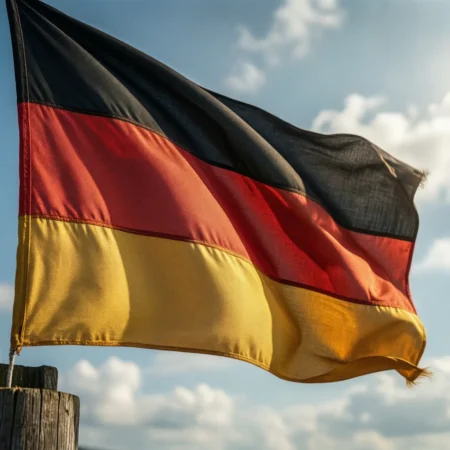
Germany’s national anthem is known as “Das Lied der Deutschen” (“The Song of the Germans”).
The lyrics were written by August Heinrich Hoffmann von Fallersleben, and the melody was composed by Joseph Haydn in 1797.
Today, only the third verse is officially used as the national anthem of Germany.
Official German Lyrics
Das Lied der Deutschen – Third Verse

Einigkeit und Recht und Freiheit
für das deutsche Vaterland!
Danach lasst uns alle streben
brüderlich mit Herz und Hand!
Einigkeit und Recht und Freiheit
sind des Glückes Unterpfand;
Blüh’ im Glanze dieses Glückes,
blühe, deutsches Vaterland!
English
Unity, Justice, and Freedom
Unity and justice and freedom
for the German fatherland!
Let us all strive for these
together, with heart and hand!
Unity and justice and freedom
are the foundation of happiness;
Flourish in the glow of this happiness,
flourish, German fatherland!
Germany National Anthem – Every Word Explained in Historical Context
Germany’s national anthem, “Das Lied der Deutschen” (third verse), is not a collection of decorative words but a carefully shaped civic statement rooted in Germany’s historical experience. Every word reflects a specific moment, struggle, and aspiration that developed long before Germany became a modern democratic state.
The anthem opens with “Einigkeit” (unity), a word that carries deep historical weight. When the lyrics were written in 1841, Germany was not a single country but a patchwork of independent kingdoms and principalities. Unity did not mean military strength or territorial ambition; it meant overcoming internal division and building a shared political and cultural identity. The word expresses a longing for cohesion after centuries of fragmentation.
This is followed by “Recht” (justice or law), a deliberate reference to the rule of law. In the nineteenth century, many German states were governed by absolute or semi-absolute monarchs. Citizens lacked consistent legal protection, and rights varied from region to region. By placing justice at the center, the anthem reflects the liberal demand for constitutions, equal laws, and limits on state power. Justice is presented as the structure that holds society together.
The next word, “Freiheit” (freedom), speaks directly to the political repression of the time. Freedom of speech, assembly, and thought were heavily restricted, and censorship was common. This word reflects the ideals that later fueled the revolutions of 1848. In the anthem, freedom is not chaotic or uncontrolled; it is freedom anchored in law and shared responsibility.
The phrase “für das deutsche Vaterland” (for the German fatherland) does not refer to borders or expansion. In its historical context, “fatherland” meant a community bound by language, culture, and values rather than conquest. The anthem defines the nation through principles, not territory.
When the lyrics continue with “Danach lasst uns alle streben” (let us all strive for this), the tone shifts from ideal to action. This line reflects the belief that unity, justice, and freedom are not granted by rulers but must be actively pursued by citizens. It places responsibility on the people themselves.
The word “brüderlich” (brotherly) is especially significant in a society once divided by rigid class structures. It calls for solidarity across social boundaries, emphasizing equality and mutual respect. This idea was radical in an era where nobility, workers, and peasants lived under vastly different conditions.
The phrase “mit Herz und Hand” (with heart and hand) combines moral conviction with practical effort. “Heart” represents belief, empathy, and ethical commitment, while “hand” symbolizes labor and action. Together, they suggest that citizenship requires both intention and participation.
The repetition of “Einigkeit und Recht und Freiheit” reinforces these values as permanent foundations rather than temporary goals. In German political culture, repetition strengthens commitment, turning the anthem into a shared pledge.
The line “sind des Glückes Unterpfand” (are the guarantee of happiness) reflects a rejection of power-based nationalism. Happiness, according to the anthem, does not come from dominance or military success but from stable laws, shared freedom, and unity.
The closing imagery—“Blüh’ im Glanze dieses Glückes, blühe, deutsches Vaterland!”—uses growth rather than victory as its symbol. Blooming suggests patience, peace, and continuity. The anthem ends not with triumph but with hope, expressing confidence that a nation grounded in these values will endure.
In this way, Germany’s national anthem functions as a historical promise. Every word ties the nation’s identity to lessons learned from division, repression, and renewal, making the anthem a statement of democratic intent rather than national pride alone.

Historical Background of the Anthem
The melody of Germany’s anthem was originally composed by Joseph Haydn for the Austrian emperor. In 1841, Hoffmann von Fallersleben wrote the lyrics during a period when Germany was divided into many states.
After Germany’s unification in 1871, the song gained popularity as a symbol of national identity. However, during the Nazi era, the first verse became associated with expansionist ideology, which permanently changed how the song was viewed.
Following World War II, Germany officially adopted only the third verse in 1952, reaffirmed again after reunification in 1990. This choice reflected a clear break from the past and emphasized democratic values.
Today, the anthem is sung at official state occasions, international events, and sporting matches, representing modern Germany’s commitment to freedom, equality, and the rule of law.


No Comment! Be the first one.